
Introduction
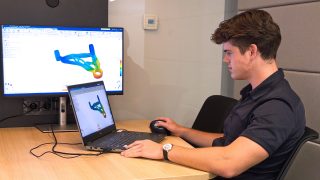
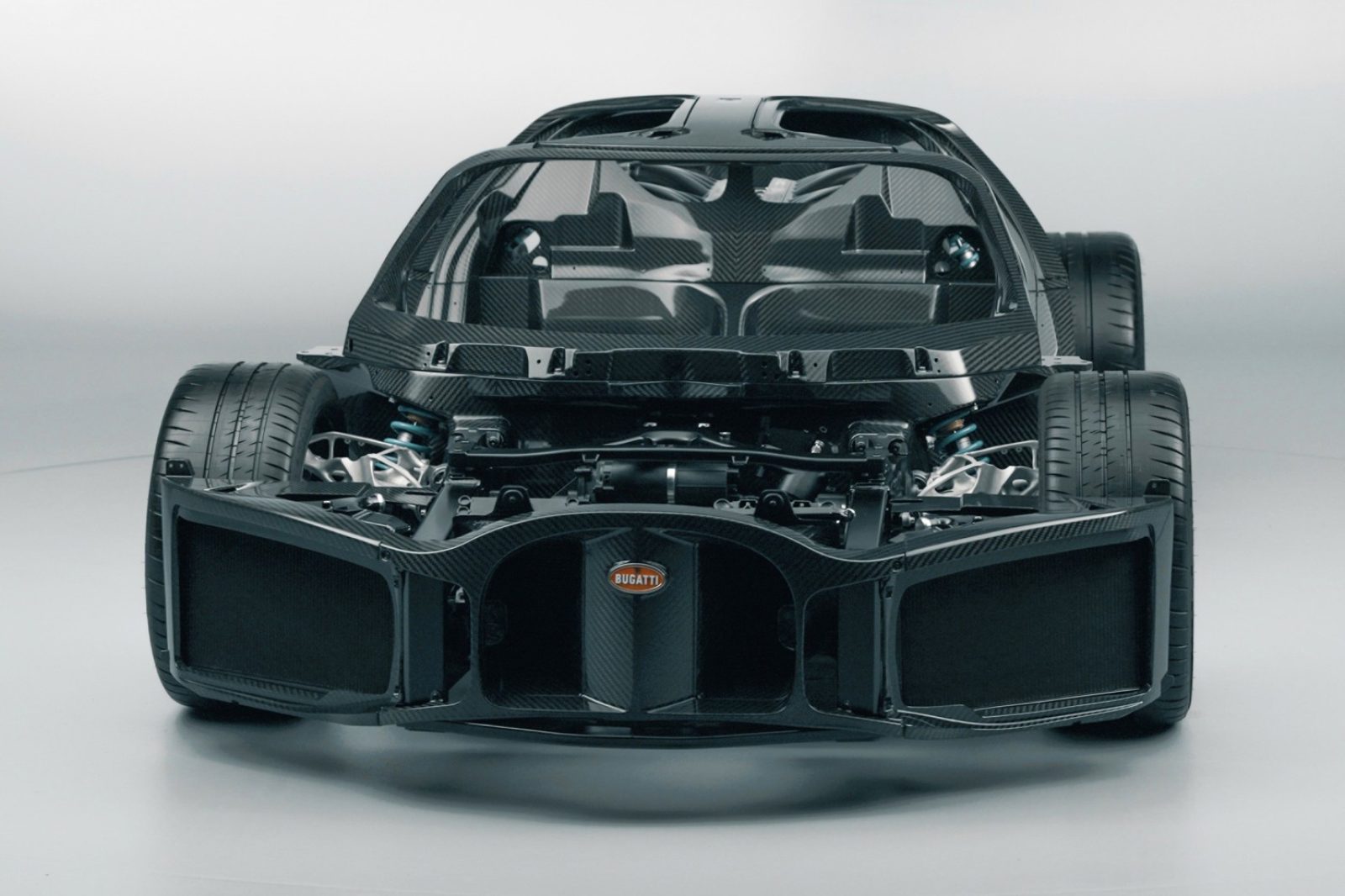
Sometimes a learning journey does not start with a customer request, but with a moment of wonder. For Benjamin, Mechanical Engineer at MechDes, that happened while watching an episode of TopGear on YouTube. In the episode, the BUGATTI Tourbillon was shown, featuring, among other things, a 3D metal-printed wheel suspension. The upper arm was topologically optimized and had an almost organic shape, as if nature itself had drawn the lines.
That observation led to a simple but telling question: how could I design such a component myself? Not for Bugatti Rimac, but as a learning project to experiment with design tools that were new to him. With support from his team leader and experienced colleagues, Benjamin started a journey that delivered more than just a virtual component. Thanks to the internal knowledge already present among colleagues, built up in earlier customer projects, he was able to benefit immediately from a head start. It became a personal exploration of how new manufacturing techniques such as 3D metal printing are changing our profession, and how you grow by stepping out of your comfort zone.
Bugatti Tourbillon
What topology optimization means for the modern engineer
Topology optimization is a design method in which software searches for the most efficient distribution of material. The result is a lighter structure that still remains stiff. In this project, Benjamin used Ansys Discovery, set up to optimize for maximum stiffness within a defined material volume and load conditions. An important detail: the calculation generally does not take material failure or strength limits into account, but only deformation. That is why additional strength analysis is necessary to meet common industry standards before a component can actually be taken into production.
The results are often surprising: irregular, organic shapes that look very different from what an engineer would traditionally draw. Yet it is not automation that replaces the human. Initially, the model looked more like a spider web. The strength lies precisely in the collaboration: the software calculates, the engineer defines the loads, the boundary conditions, and manufacturability. That is how you arrive at a design that will truly work in practice.
What fascinated me was not so much the Bugatti itself, but the question: how far can I get if I start working with this technology myself?
This creates a dynamic in which new forms become possible, while the insight and experience of the engineer remain decisive. That is also why it was valuable to brainstorm together with direct colleagues Helmig, Nick, and Rémon, who enthusiastically joined in when Benjamin shared the Bugatti episode that inspired him.
From idea to concrete model: how a learning project took shape
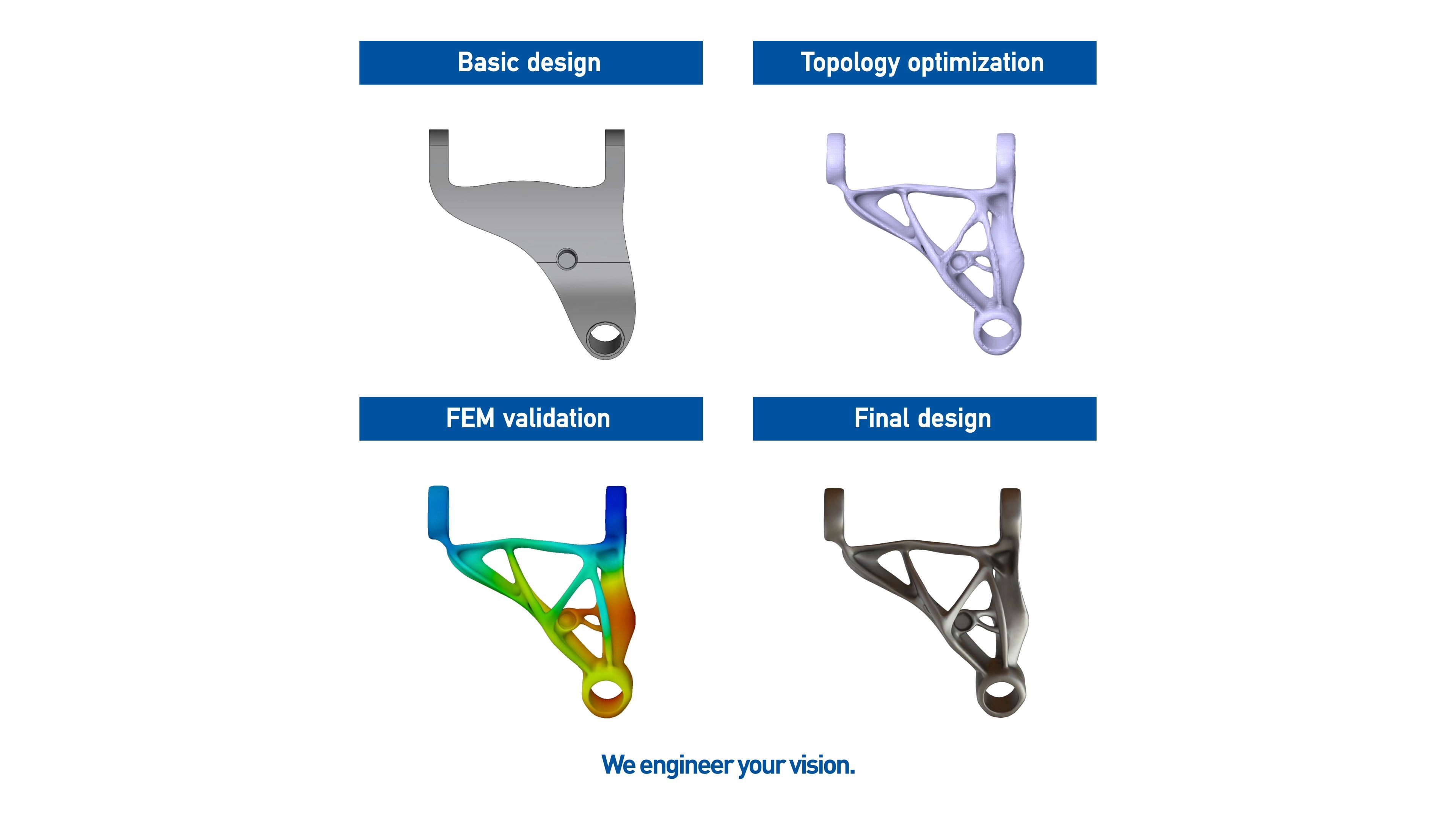
Benjamin did not start with a fully developed design, but with a foundation: a simple 3D model in SOLIDWORKS (Dassault Systèmes) containing only mounting points and available space. This framework gave the software the freedom to search for the optimal shape.
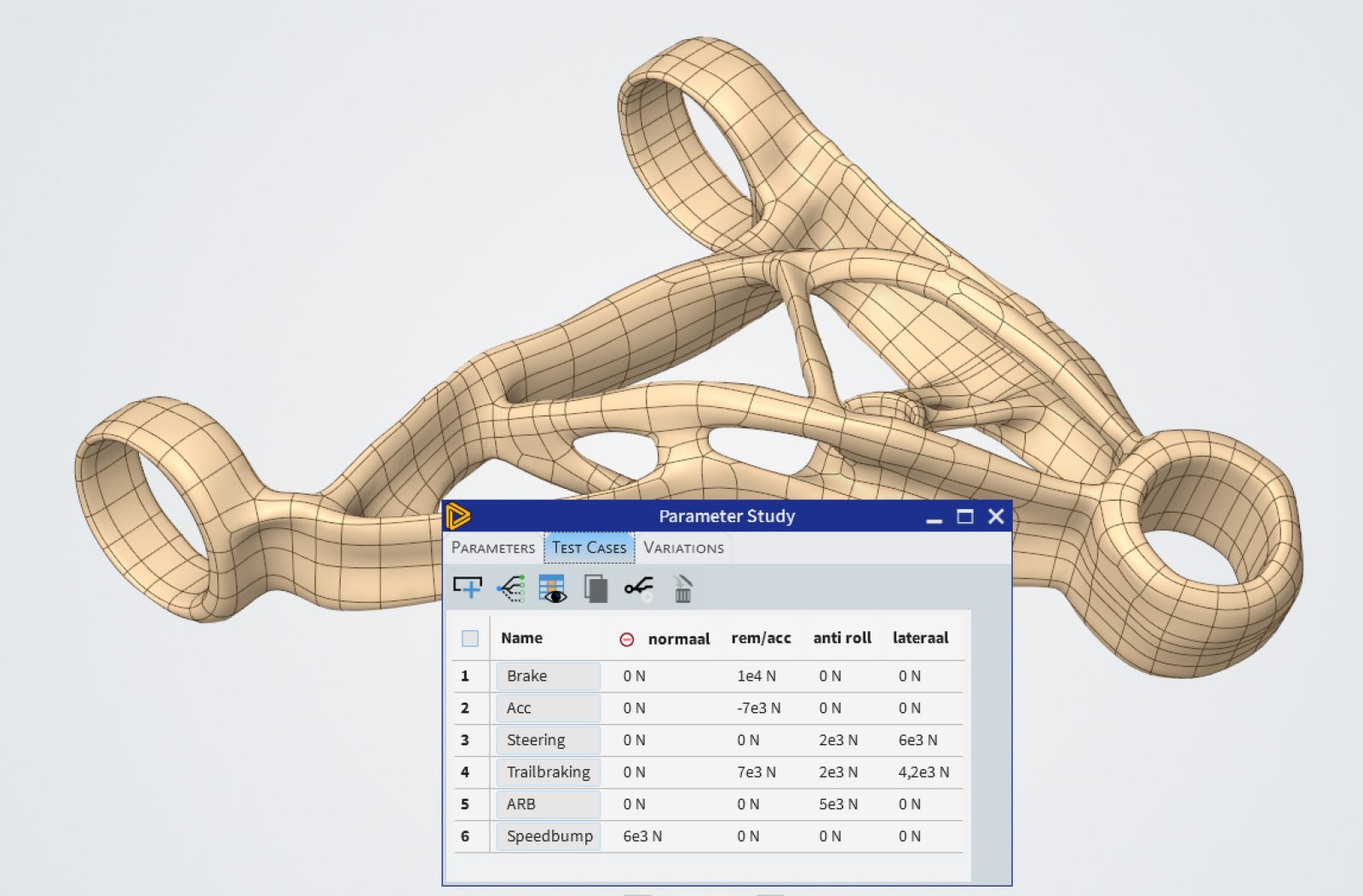
Benjamin then defined six realistic load cases, ranging from braking and accelerating to braking while cornering and the forces from the stabilizer bar. By including multiple scenarios, the design became more relevant and more applicable.
With this input, he let Ansys Discovery perform the calculations. In a short time, the process delivered a range of possible shapes, varying depending on the chosen settings. Every change in loading, material distribution, or constraint resulted in a different outcome. This showed how important the engineer remains: the software provides options, the human determines usability.
From rough shape to usable design: the value of FEM analysis
The first result of a topology optimization is a rough faceted model, built up from thousands of small surfaces. Interesting to look at and a good starting point, but certainly not ready for use. Benjamin transformed the rough faceted model into a usable CAD model, making it suitable for analysis and production.
Then came the next challenge: validating what you have designed. Using a Finite Element Method analysis (FEM/FEA), he recalculated all previously defined load cases. The results showed where peak stresses occurred and how large the deflection was. This made it clear whether the design could withstand the forces in practice.
This is essential, especially for a hypercar such as the Bugatti Tourbillon, which is estimated to have 1,800 hp and a top speed of up to 445 km/h. With such extreme performance, even small geometric errors or weaker points can be catastrophic.
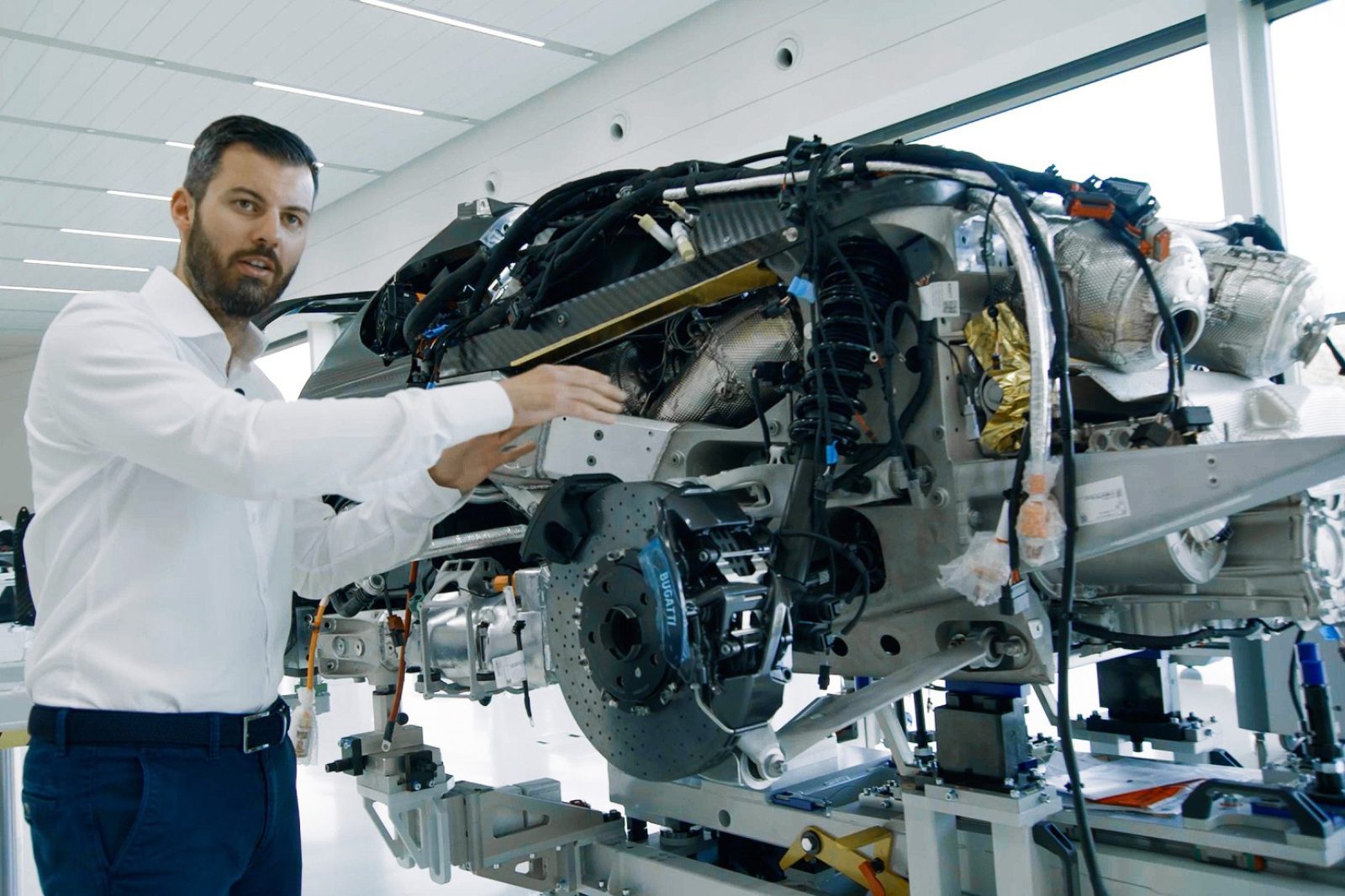
Although the risks are extreme for hypercars, FEM also plays an increasingly important role for ‘regular’ cars. Mainstream and affordable cars are also analyzed and validated using FEM. Simulation techniques help optimize components such as suspension systems, chassis, and Crash Management Systems (CMS), even in mass production.
For example, automotive brands such as BMW Group use CAE (Computer-Aided Engineering) to design suspension systems that combine performance, comfort, and reliability. And at OEMs and suppliers, FEM has become a standard tool for testing structural strength in advance, reducing physical prototypes and ensuring quality.
Why experiments like these matter for engineers and clients
What makes this project special is that it was not a customer assignment. It was a learning project, driven by curiosity and personal motivation. At MechDes, we actively encourage that. Engineers are given room to explore new tools, make mistakes, and broaden their knowledge.
This way of working delivers more than technical knowledge alone:
- Engineers develop faster by stepping outside their comfort zone
- The enjoyment and pride that arise during such a journey strengthen intrinsic motivation
- For clients, this means our experienced engineers are ready with up-to-date knowledge and fresh ideas
In short, for us, self-development is not a luxury; we also see it as an HR investment in our talent. By giving engineers room to grow, we invest directly in the quality of our work and the innovative strength of MechDes.
What topology optimization can concretely mean in practice
The insights from this learning project are not only relevant for hypercars, but also for other sectors where lightweight design and efficiency matter. Moreover, the applications extend beyond additive manufacturing alone, for example in:
- Automotive: lighter and more efficient suspension parts and frames
- Machine building and intralogistics: grippers and tooling that use less material but can handle more force
- Special equipment / Offshore: robust and durable structures specifically designed for demanding environments, where innovation goes hand in hand with efficient material use and cost savings
The benefits go beyond weight reduction alone. Less material also means less energy in production and use, contributing to sustainability and efficiency. Our Managing Director and visionary Henk van Ommeren is a strong supporter of the principle "Less = More." At MechDes, this is such an important theme that a Less = More Award has been created. The engineer who realizes the most innovative "less = more" idea wins the award.
The future of design: when digital optimization meets additive manufacturing (3D printing)
The true power of topology optimization really comes into its own in combination with additive manufacturing. Where traditional production techniques have limitations, 3D printing makes it possible to actually produce organic shapes, combine functions and components, and shorten production chains.
This opens up perspectives for lighter machines, more sustainable designs, and innovative structures that used to be impossible. Yet the role of the engineer remains crucial: the algorithm does not take tolerances, safety standards, or manufacturability into account. The future of engineering lies in the balance between computing power and human insight.
In fact, with additive manufacturing, a lot of work shifts from production, logistics, and assembly to the engineering phase. Precisely at the front end, you need to make the right choices to ensure the design functions optimally.
Conclusion: curiosity as the engine for innovation
What started with a fragment from a well-known TV program on YouTube grew into an educational project that showed how modern tools are changing our profession. For Benjamin, it meant personal growth and deeper engagement with new techniques, building on the experience and knowledge of his experienced colleagues. For MechDes, it underlined how important it is to give engineers room to experiment.
Topology optimization is not a miracle solution, but it is a powerful tool that shows how engineering can become smarter and lighter. By working with it now, we prepare ourselves for the challenges of today and tomorrow.
The most important lesson may be this: innovation often starts with curiosity and the courage to say: how could I do this myself?
Room to learn at MechDes
MechDes is a mechanical engineering firm with more than 30 years of experience in the development of special equipment and tooling & machines. We operate in various markets, including automotive, energy and offshore, intralogistics, civil and water, manufacturing industry, and machine building. In every project, we combine technical expertise with involvement and innovation, always focused on sustainable and efficient solutions.
Our engineers combine innovation, thoroughness, and involvement with a sharp eye for practical manufacturability. Within MechDes, every engineer is given the room to learn, challenge themselves, and be proud of the result. Precisely when enjoyment and curiosity are central, designs emerge that help our clients move forward.