
Introduction
I have now been working for almost five years as a Senior Mechanical Engineer at MechDes in Harderwijk. Since graduating seven years ago, I have been designing complex machines for the infrastructure and offshore sectors on a daily basis. In addition, I perform FEM/FEA calculations on these designs and act as a key user of our PDM platform for special equipment. So every day, I am fully engaged with technology and technical challenges.
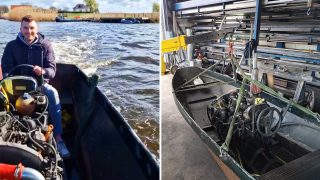
And when I get home, I notice that the same passion continues. About six years ago, this led to a project that required all of my technical knowledge as well as creativity: converting an old steel dinghy into a Kameleon-style speedboat, complete with a Volkswagen Golf TDI engine and jet propulsion. What started as a hobby has now become a floating test environment for manufacturability, simple solutions, and corrosion knowledge that I apply in my daily work at MechDes.
From a Marketplace dinghy to a Digital Hull?
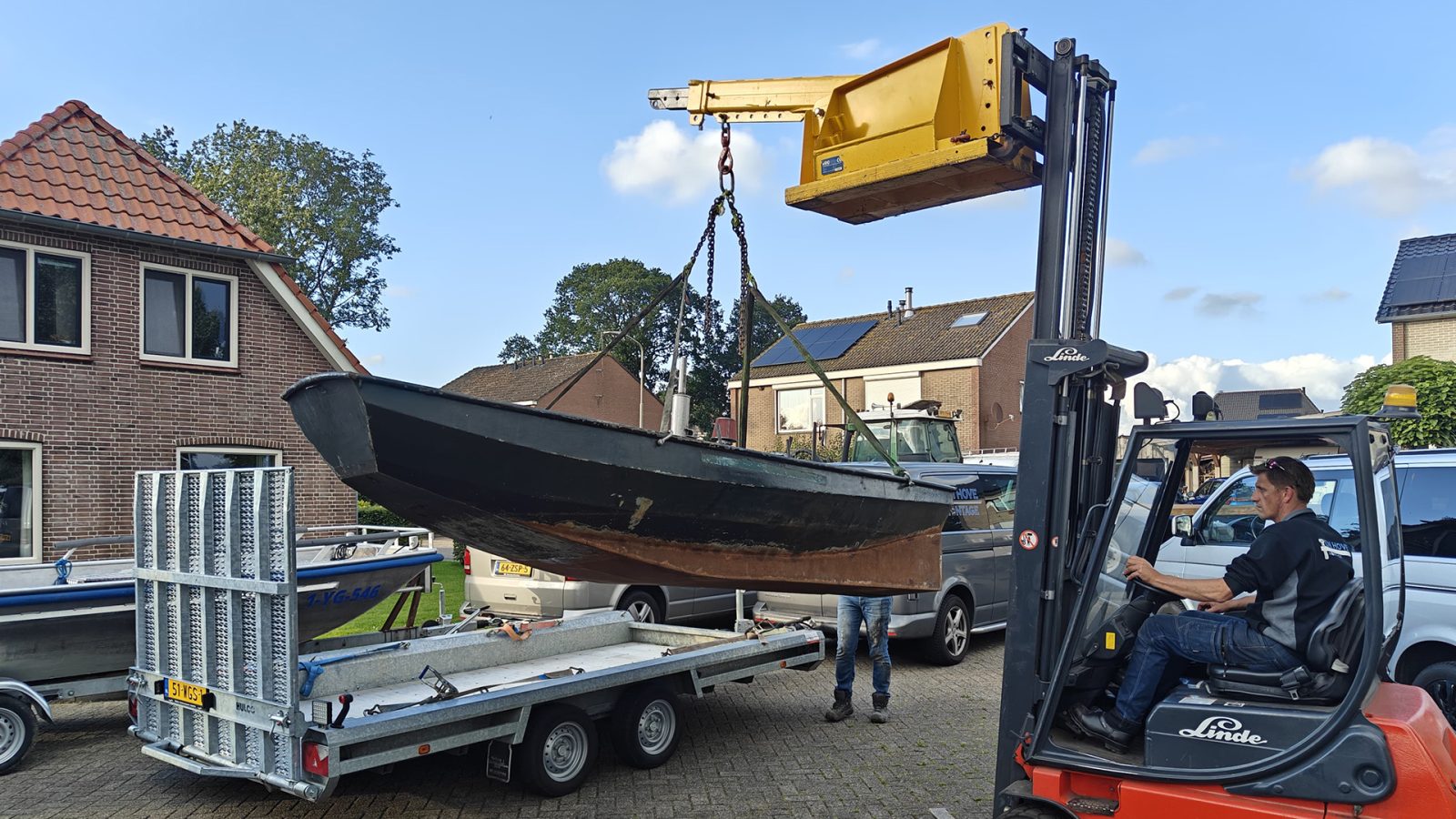
The idea came right after graduation, together with my former colleague Gerrald Kwakkel, now working at AWL: why not build a boat together? We wanted a dinghy with a car engine, just like in the Kameleon books. Through Marktplaats, we found a four-meter-long steel dinghy, narrow at both the bow and stern, and a 1.9 TDI engine from a 2004 Volkswagen Golf, producing around 100–130 hp. Free, second-hand, and perfect for our low-budget experiment.
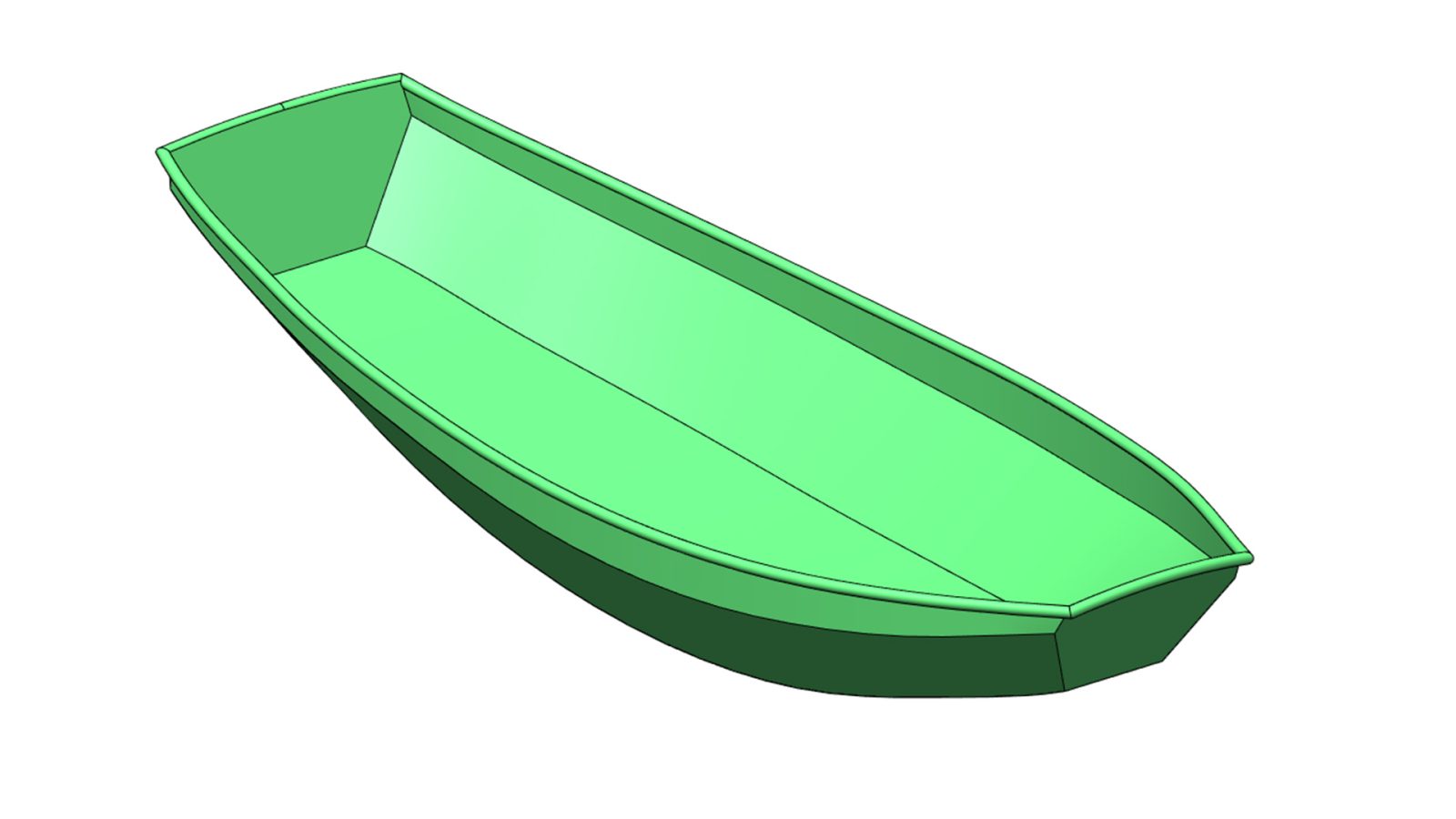
The first question: would this thing even float? A dinghy is smaller and lighter than a car, and weight plays a crucial role. We measured the boat and recreated it in SolidWorks. This allowed us to calculate buoyancy, and we concluded that without modifications, the boat would nearly sink with the engine and jet installed. Time for intervention:
- The rear was widened by half a meter.
- The curved "banana" hull was replaced with a flat bottom for increased buoyancy and planing performance.
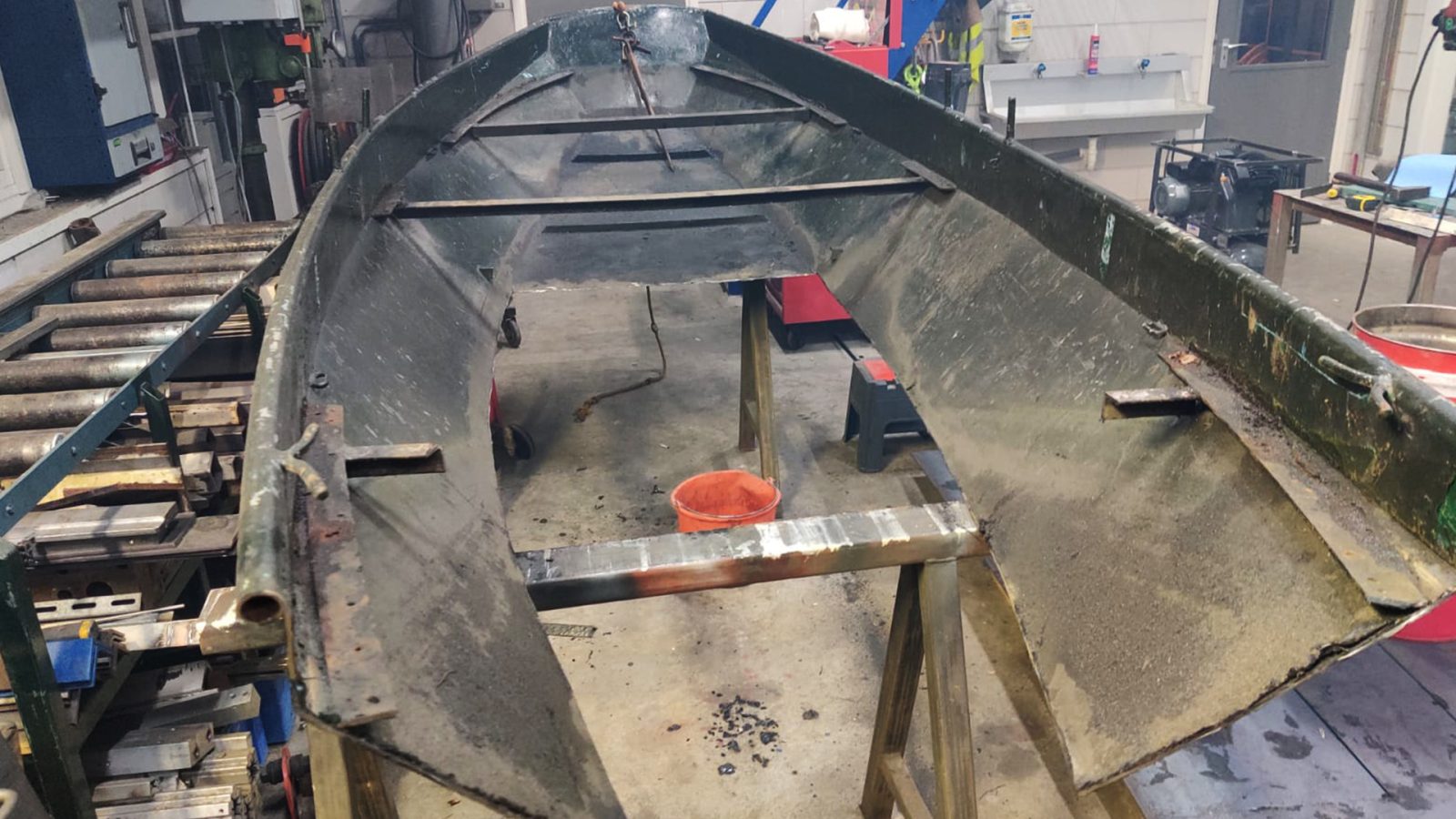
The real work took place in a workshop owned by an acquaintance: cutting out bottom plates, pressing the sides, and welding in new sections. The 3D model provided direction, but hands-on measuring, fitting, and adjusting proved essential. This is where the value of practical experience became immediately clear: theory is one thing, making steel behave the way you want is another.
Jet Propulsion: A Choice for Shallow Water
The next question: propeller or jet? Because we operate on the shallow Veluwemeer and want to access the harbor of Elburg, we chose a jet unit:
- A propeller extends below the hull, making it vulnerable and prone to collecting weeds.
- A jet is integrated into the hull, drawing in water and expelling it aft, resulting in minimal draft.
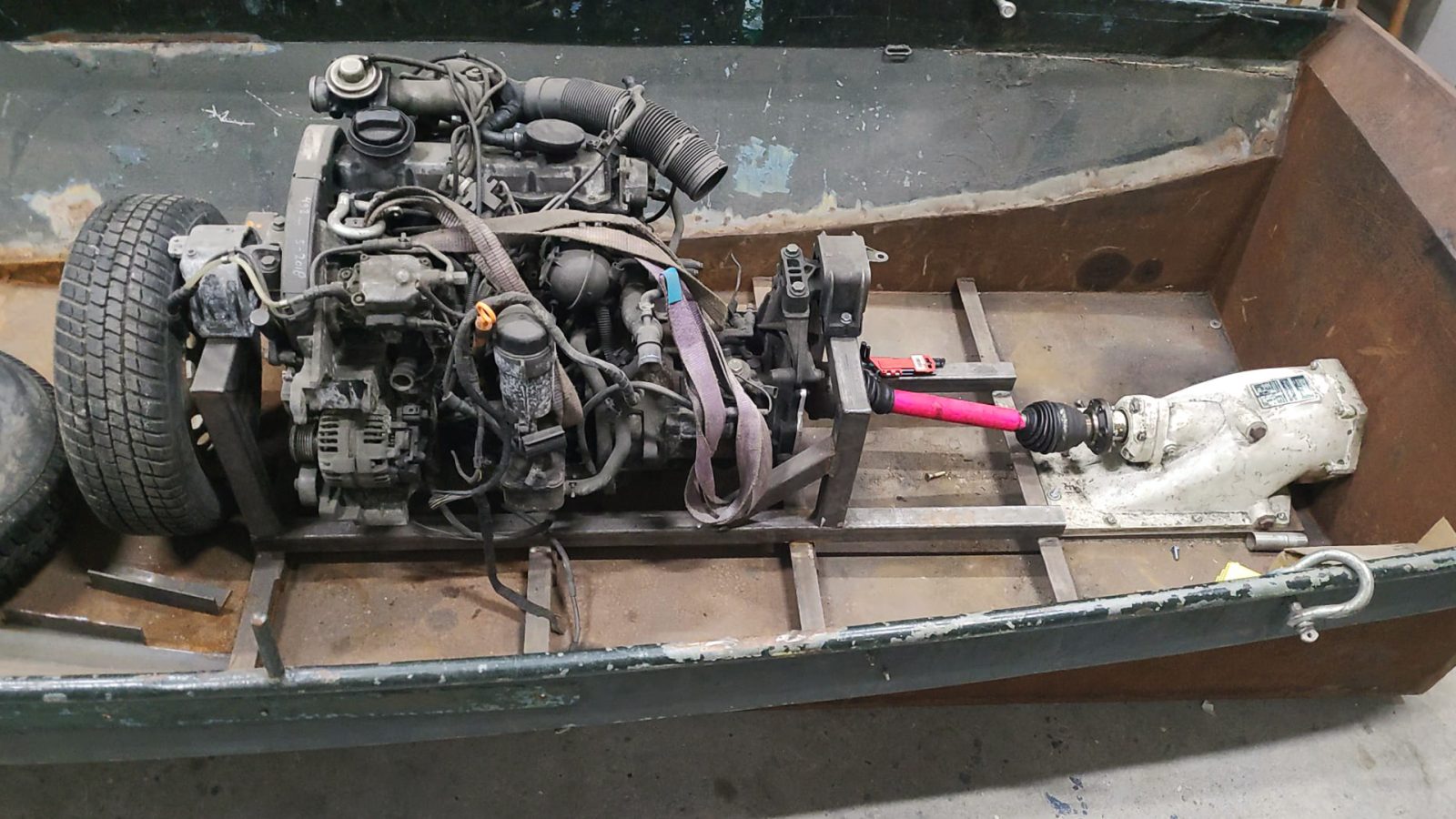
We found an old jet unit from the 1950s, made of solid cast aluminum. Its operating point of 4000 rpm matched well with the TDI engine. To reduce losses, we largely disassembled the gearbox and connected the output shaft directly to the crankshaft, retaining only a manually operated clutch. This allows the boat to idle without immediately moving forward.
Driveshaft and Safety: Engineering with Intuition
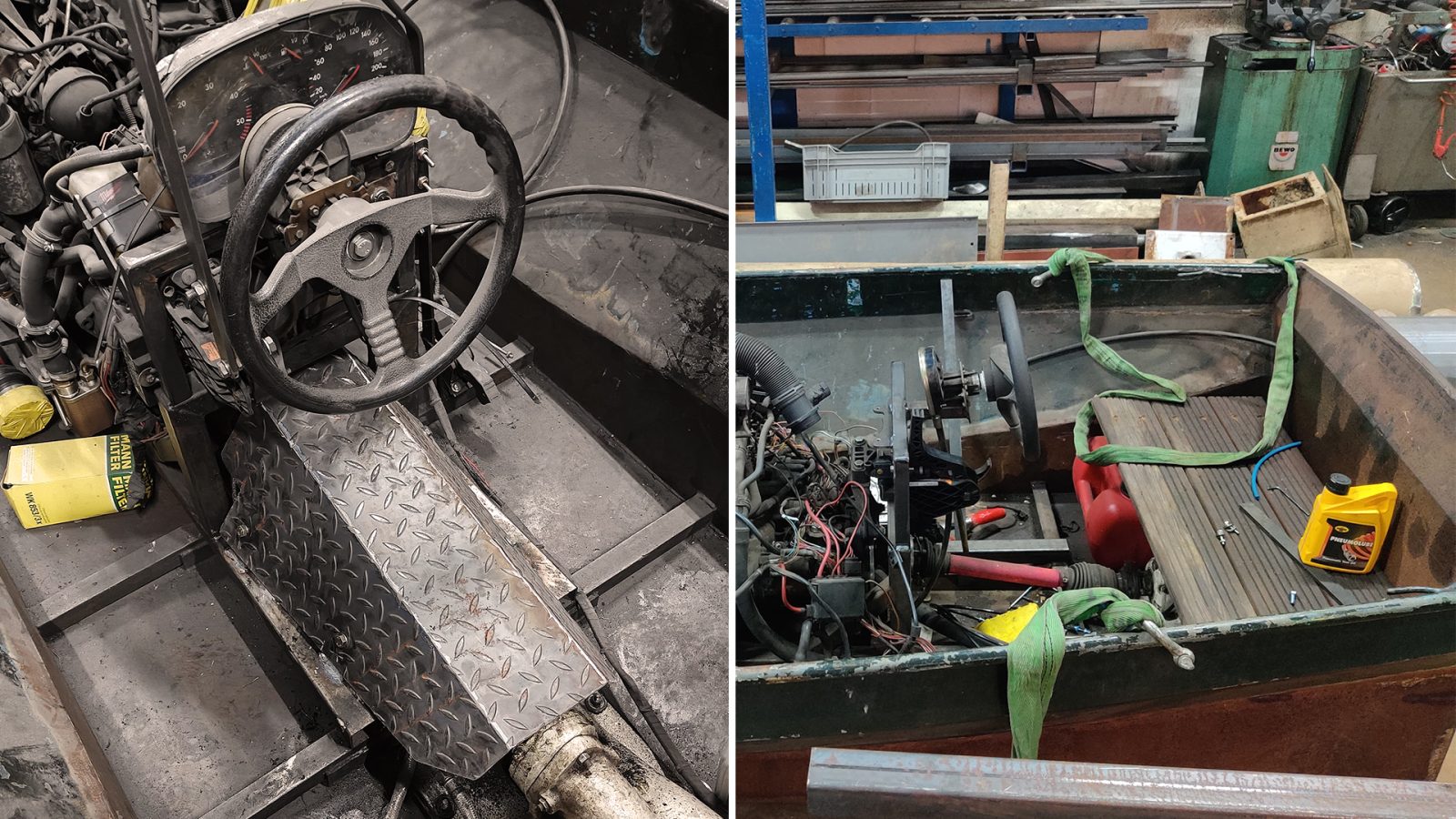
The driveshaft was the next critical step. We reused the original shaft with CV joints from the car, cut it to size, and welded it into a new configuration. Safety was the top priority: the shaft runs between the driver’s legs. That is why we welded a 5 mm thick steel tunnel around it, ensuring protection for the occupants even in case of failure.
We have already conducted several test runs to evaluate durability and identify possible improvements. During these tests, I noticed that the flat bottom started to flex at high speeds. Additional stiffeners provided the solution, making the structure significantly more rigid and stronger. Practical feedback like this is extremely valuable: you literally feel what steel does, and that experience directly translates into my work at MechDes.
Cooling, Intercooler and Exhaust: Water-to-Water Engineering
A car relies on airflow and a radiator; a small dinghy does not. That is why we cool the TDI engine using a water-to-water heat exchanger: the coolant circulates through the engine in a closed loop. Cold water is pumped from the lake by the jet, filtered, and passed through the heat exchanger. The turbo intercooler is now also water-cooled, keeping the intake air denser and more efficient. We also continuously draw in fresh air, which increases speed but does not necessarily benefit fuel consumption.
The exhaust is currently pragmatic: a muffler with an upward pipe. A quieter, wet exhaust system may follow later. The guiding principle is simple, functional, and low-budget, aligned with the "less is more" concept.
Corrosion and Coatings: Learning from Offshore Experience
Through my work at MechDes on offshore and underwater projects, such as underwater turbines, locks, and weirs, I was immediately aware of corrosion risks. The dinghy combines steel, aluminum, and stainless steel in a wet environment, making galvanic corrosion a real concern. To mitigate this, we made several carefully considered design decisions:
- Material combinations in the hull, supports, and connections are selected with care.
- Connections are insulated wherever possible.
- The hull will receive a multi-layer coating system, with extra attention to seams and hard-to-reach areas.
For now, the dinghy is still in the workshop with some surface rust, but the next step is blasting and coating, where the industrial experience of Gerrald and myself will be directly applied.
Electronics and Wiring Harness: Engineering in Detail
The wiring harness of the Golf engine turned out to be quite a challenge. When we picked up the free engine, we cut everything because we only had one evening for disassembly. Years later, we discovered that the original ignition key was missing, and the ECU therefore blocked the engine from starting.
Using Volkswagen wiring diagrams and with help from my father, an aircraft mechanic, we rebuilt everything. Since the dinghy does not have electric windows or wipers, we were able to rebuild the wiring harness entirely according to the "less is more" principle: removing unnecessary wires, saving weight, and retaining only essential sensors and actuators. We then modified the immobilizer so the engine could start with a regular key.
The result is that the dashboard functions just like in the car: tachometer, coolant temperature, everything works. Speed is measured via a GPS app, as a traditional speedometer is not applicable without wheels. During initial test runs, the Kameleon reached 58 km/h, or 31 knots, delivering a real thrill and proving that all the wiring efforts paid off.
Practical Boating Requirements: Safety and Comfort
Engineering is one thing, regulations and safety are another. Fast motorboats exceeding 20 km/h require a boating license, and there are speed limits in urban areas and harbors. For the Kameleon, this means:
- Boating license required
- Registration number must be installed
- Functional kill switch
- Fire extinguisher, life jackets, and basic safety equipment on board
In terms of comfort, planned additions include a wooden deck floor, seating benches, storage compartments, and an engine cover with sound insulation. The battery box and diesel tank are positioned in the bow for improved trim and stability.
What It Teaches Me as a MechDes Engineer
What this project mainly shows me is the value of manufacturability. Theory is one thing, but feeling what steel does, seeing how a shaft responds, and experiencing what corrosion means provides insights that no drawing or calculation can replace.
Through this project, we have already encountered several practical lessons:
- Welding causes deformation; slots and symmetrical welding sequences make a difference.
- A theoretically strong shaft still requires a physical shield for safety.
- Material selection and corrosion protection determine whether something lasts for years or fails within a single season.
I apply these lessons daily at MechDes, where we design special machines and offshore equipment that must perform under even more demanding conditions. The Kameleon with a VW diesel is therefore not just a hobby project, but a floating learning platform that aligns perfectly with the MechDes mindset: delivering quality, avoiding unnecessary complexity, measuring, testing, and optimizing. And I am already looking forward to a beautiful summer day when we take the Kameleon out onto the lake and I can enjoy how everything has come together so well.
A Floating Laboratory
Building the Kameleon dinghy truly teaches me a lot about manufacturability and helps me develop a real feel for what I design behind a screen every day. Each step brought new insights: what works, what fails, and what requires a smarter adjustment. In that sense, the dinghy is a floating laboratory, where ideas are tested directly and solutions take shape in practice.
The best part of this project? Bringing an idea to life, feeling how materials respond, and learning from every mistake. It reflects exactly the way of working I value at MechDes: being involved in every detail, combining innovation with craftsmanship, and taking pride in what we achieve together. Curiosity remains the compass, as the next challenge is already waiting for us. The dinghy is far from finished.
About MechDes Engineering
At MechDes, everything revolves around engineering that truly works. For over thirty years, we have been designing and realizing special machines and tooling for the infrastructure, offshore, and manufacturing industries. We combine in-depth technical knowledge with practical experience to ensure our designs are reliable, efficient, and future-proof. We always keep the bigger picture in mind: working closely with our clients, continuously seeking better solutions, and taking pride in what we achieve together. Just like with the Kameleon dinghy, measuring, testing, improving, and learning from experience are at the core of everything we do.