
Introduction
The world of intralogistics is changing at a rapid pace. Products and packaging are becoming increasingly diverse, while the pressure on logistics processes continues to grow. Consumers expect faster delivery times, webshops demand flexibility, and profit margins are under pressure. Companies are looking for systems that are not only reliable, but also capable of adapting quickly to new market demands.
In machine building, robust standard solutions have traditionally been the norm. For many years, these solutions performed exceptionally well. However, today’s challenges require a different approach. How do you combine speed, precision, and flexibility in a single system that also remains scalable and cost-efficient? It is a question the industry has been grappling with for years, and one that is more relevant than ever.
Why the traditional approach no longer works
Traditionally, innovation followed long, linear cycles: from idea to design, from build to test. This often meant months of work before the first real insights emerged. If fundamental issues surfaced at that stage, it required significant time and cost to start over.
In a world where markets continuously evolve, that pace is no longer sustainable. Companies must be able to adapt, vary, and learn in much shorter cycles. The solution? Rapid Prototyping: an approach centered on fast iteration, embracing mistakes, and learning from them immediately.
Rapid Prototyping is not about rushing; it is about intelligently reducing risk. By making ideas tangible sooner, it becomes clear much earlier what works and what does not. This prevents valuable resources from being invested in designs that ultimately prove unviable.
From gripper to intelligent handling system
The shift toward greater flexibility in intralogistics is clearly visible. At the international trade fair automatica in Munich, this trend was once again confirmed. In addition to the well-known industrial giants dominating robotics, there was remarkable attention for end-of-arm tooling. Particularly in palletizing applications, the variation remains limited: most systems are designed for just one type of packaging.
"That is exactly where both the challenges and the opportunities lie," Martijn explains. "The market demands systems that are flexible enough to handle different products reliably, without requiring a completely new gripper for every situation."
The first steps toward that flexibility have already been taken. Innovations such as robotic hands capable of rotating a cube, or fingers equipped with sensors that provide feedback on gripping force, bring tactile sensing and adaptability closer to reality. They make robots slightly more human. The next step goes even further: full integration with the robot arm and the Vision/AI system.
From idea to insight
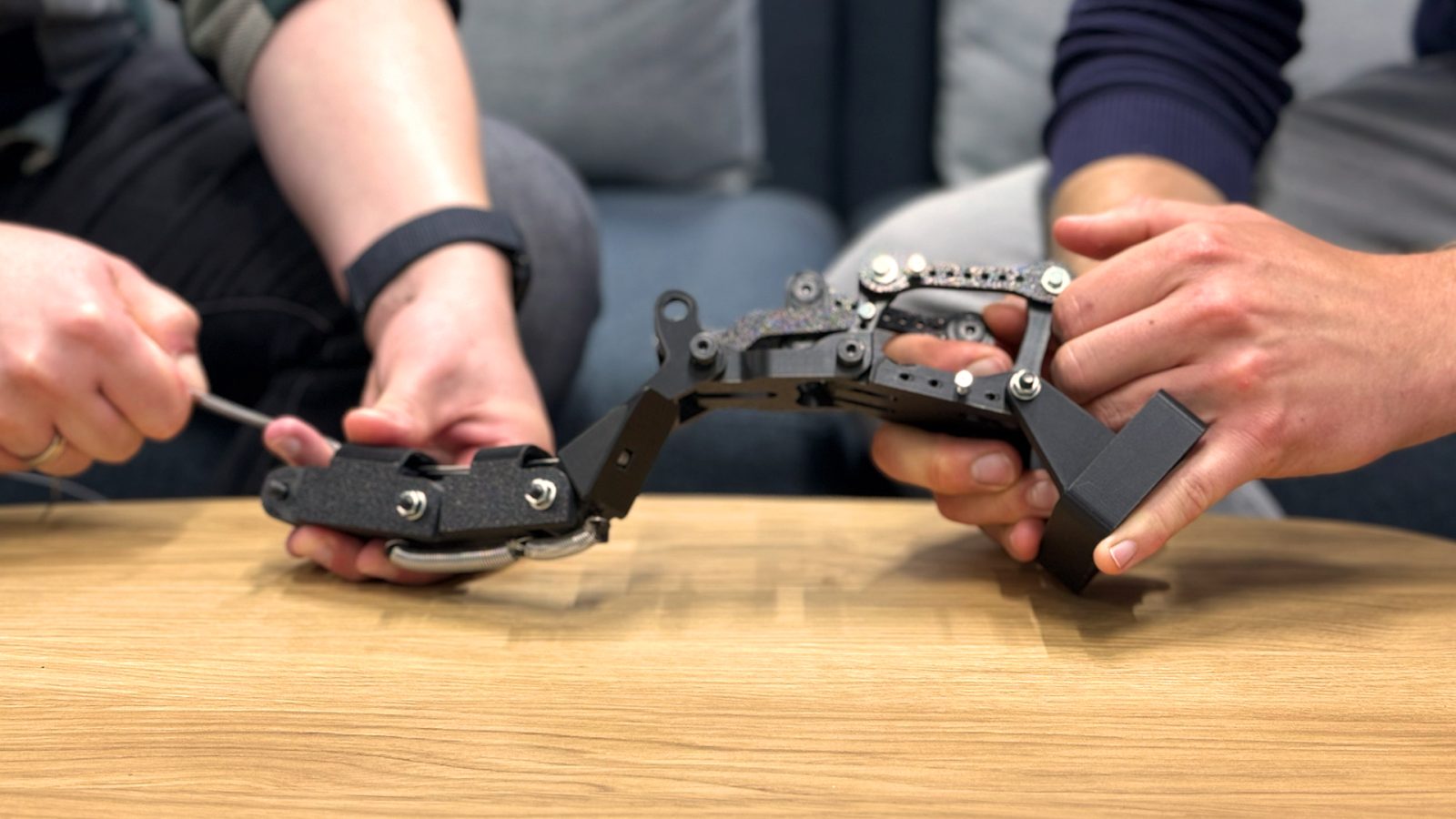
Rapid Prototyping aligns perfectly with this development. The principle of fail fast, learn faster means you do not endlessly refine a concept before testing it, but instead make it tangible as quickly as possible. This can be an early version of a mechanical component, a digital simulation, or a simple test setup.
Having a prototype in your hands immediately leads to valuable insights:
- Does it function as intended?
- Where are its limits?
- Which improvements are truly necessary, and which are simply enhancements?
Innovation thus shifts from a linear process to a learning process built on short, repeatable steps. Small interim deliverables create flow within the design process. This increases speed and prevents major corrections later on.
Speed, flexibility, and functionality
The major advantage of Rapid Prototyping is that functionality becomes visible much sooner. New ideas are tested and improved immediately, allowing solutions to mature faster. And if an idea does not work, that becomes clear quickly as well. This makes it possible to pivot toward an alternative with real potential, without significant loss.
This approach delivers four concrete benefits:
- Time savings: issues surface earlier and can therefore be resolved sooner.
- Improved functionality: by testing multiple variants, the final design better matches real-world conditions.
- Flexibility: the process allows course corrections without losing months of work.
- Stronger engagement: having something tangible encourages colleagues to provide feedback and contribute practical insights.
As Thom puts it: "By allowing room for mistakes, we discover faster how to truly make an idea work in practice. Sometimes a simple solution outperforms a complex one — less is more."
Applications in intralogistics
Rapid Prototyping is particularly valuable in intralogistics. Modern robotic systems must reliably handle heavy boxes, lightweight packaging, and fragile products alike. The variation is enormous: irregular shapes, different materials, varying dimensions, often mixed within the same process.
With a traditional development cycle, you risk discovering only months later that a solution lacks sufficient flexibility. Rapid Prototyping significantly reduces that risk. By building, testing, and improving step by step, a system evolves organically alongside the complexity of the challenge.
The result is robotic systems that are:
- Flexible in picking and handling a wide variety of products,
- Efficient in their use of energy and resources,
- Sustainable in environments characterized by continuous change.
This makes Rapid Prototyping highly relevant not only for warehouses and distribution centers, but also for sectors such as e-commerce, food, and pharmaceuticals. Wherever flexibility and reliability are critical, this approach delivers added value.
Learning and improving together
Rapid Prototyping is not only about technology; it is also about collaboration. Engineers, operators, and clients jointly evaluate what works and what does not. Each iteration brings the solution closer to the desired functionality.
A prototype does not have to be perfect. It mainly needs to clarify what the next step should be.
This shared learning curve ensures that all stakeholders develop a sense of ownership at an early stage. Clients gain insight into how a concept evolves, allowing their feedback to be incorporated immediately. This prevents surprises at the end of the process and increases the likelihood of delivering a solution that truly fits real-world practice.
Looking ahead: the power of iteration
The next generation of robotic systems will not be designed in a single step, but built progressively. By making ideas tangible more quickly, the learning curve becomes significantly steeper than before.
Manager Operations Gerrit Mulder summarizes it well: "We do not see this as a standalone innovation, but as a building block for the future." Rapid Prototyping is therefore not just a method, but a mindset. A way to accelerate innovation while simultaneously reducing risk. In intralogistics, and equally in other sectors where speed, precision, and flexibility must go hand in hand.
About MechDes Engineering
MechDes Engineering is a creative and distinctive mechanical engineering firm with more than 30 years of experience. From our office in Harderwijk, we work daily on complex challenges for clients across a wide range of industries.
We do this with a close-knit team of engineers who combine innovation, thoroughness, and commitment with a strong sense of pride. Our strength lies in partnerships: we think along from the very first sketch, develop and test smart solutions, and guide realization from start to finish.
This ensures that ideas do not remain on the drawing board, but become reality.
Our slogan is: We engineer your vision. And sometimes that requires speed: turning a vision into a prototype quickly, learning what works, and refining it further. In doing so, we bring ideas closer to real-world application faster than ever before.