
Introduction
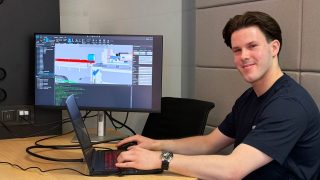
When I stepped into MechDes five months ago, I honestly did not know exactly what to expect. As a third-year ICT student, I felt at home in the world of code, applications and software architecture.
CAD systems, simulation software and mechanical engineering, on the other hand, were largely unknown territory for me. Yet that was exactly the reason why this internship appealed to me. I was looking for something that would challenge me. Something that would allow me to gain new knowledge and broaden my perspective. Looking back, I can say that is exactly what happened.
What started as an internship assignment focused on software development grew into a journey of discovery through the worlds of mechanical engineering, automation and simulation. A world that I have since learned is much closer to software development than I initially expected.
From curious student to software developer
Programming has played a major role in my life for a long time. Around the age of thirteen, I started experimenting with Python and Java out of curiosity. Simply because I wanted to understand how software worked and how you could build something yourself. Later, I took computer science classes in secondary school. That mainly confirmed that I had chosen the right direction. The real deepening came during my Software Development studies at Windesheim.
What has always appealed to me about software development is the combination of structure and creativity. You start with a problem, come up with a solution and build it step by step. Eventually, something is created that did not exist before.
That process continues to fascinate me. However, until now everything had mainly taken place within the IT world itself. During previous projects, I developed web applications, portals and other software solutions. My internship at MechDes was the first time I had to apply my knowledge within a completely different technical environment.
An unfamiliar world that quickly became familiar
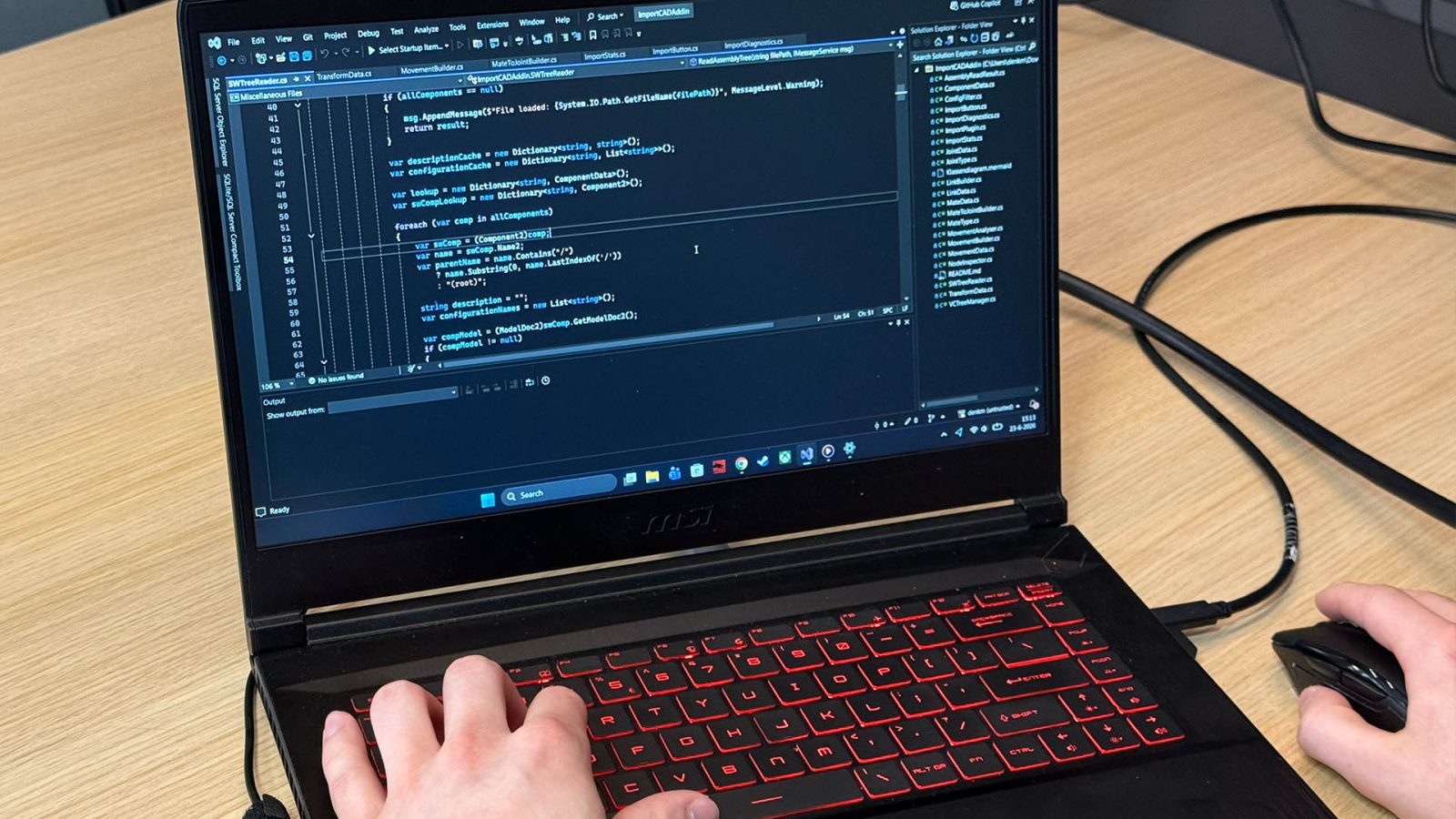
I still remember my first week getting introduced to software such as SOLIDWORKS and Visual Components. My first thought was: "How am I ever going to understand all of this?". For engineers, these are everyday tools. For me, they were completely new systems with their own logic, terminology and way of working.
Fortunately, I was given the space to first get familiar with the environment. I followed training courses, explored how the software worked and spoke with many colleagues. This helped me gradually understand how engineers use these tools during projects. What stood out to me was that the differences between software development and engineering are actually much smaller than many people think. Both disciplines are about solving complex challenges. Both require structure, logical thinking and the ability to maintain an overview. Only the final result looks different.
Where I would normally develop an application, an engineer works on an automated machine, an intelligent gripper or complex offshore equipment. The way of thinking turned out to be surprisingly similar.
Where IT and engineering come together
During conversations with engineers, I discovered that we often looked at the same problem, but from a different perspective. That led to interesting discussions. I could contribute from a software development perspective by thinking about processes, automation and efficiency. Engineers, on the other hand, looked at the technical operation of systems and their practical application. It made me realize that innovation often emerges at the intersection of different disciplines. Not because everyone thinks the same way, but because different areas of expertise strengthen each other.
That insight became even clearer when I started working on my internship assignment.
A challenge with direct impact
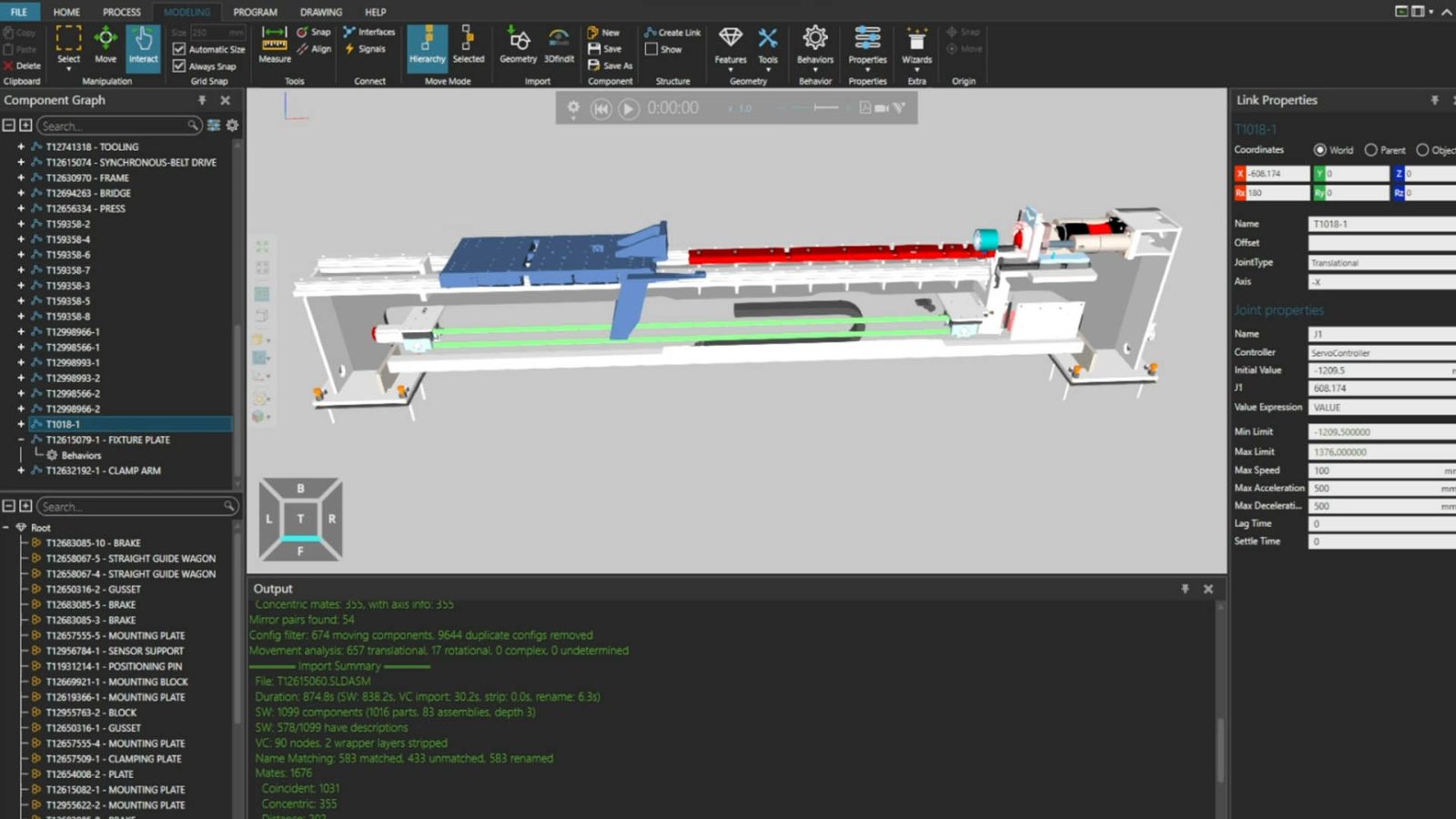
My assignment was to develop a smart connection between SolidWorks and Visual Components. On paper, this may sound like a straightforward technical software assignment, but the impact goes much further.
Within engineering, CAD models are frequently used as the foundation for simulations. For example, an engineer designs a machine in SolidWorks and then wants to analyse how that machine behaves within a simulation environment such as Visual Components.
The challenge is that a standard import mainly transfers the geometry of a model. The shape is transferred, but much of the additional information is not. This means engineers still need to perform several manual steps before a simulation can actually be used effectively.
And that is exactly where the added value lies. I developed an importer that not only reads the geometry, but also analyses additional information from the SolidWorks model. This includes the structure of components, naming conventions and motion information. As a result, a simulation-ready model can be created almost immediately. What previously had to be built manually is now largely prepared automatically.
Automation is not about less work, but about working smarter
During my internship, I learned that automation is often misunderstood. Many people immediately associate it with replacing work. In practice, it is much more often about supporting specialists. An engineer does not become less important because software takes over repetitive tasks. On the contrary. By automating recurring activities, more time becomes available for the tasks where technical expertise truly makes a difference.
I also saw this during simulation projects that I was able to experience up close. When you save time on preparatory work, more room is created for performing analyses, improving designs and identifying risks at an early stage. Ultimately, not only the engineering team benefits from this, but also the customer.
The biggest lesson was not in the software
Although I learned a lot about CAD software, simulations and software integrations, my biggest learning experience came from somewhere else. For the first time, I worked completely independently on a single project. During my studies, many assignments are carried out in groups. That has advantages, but it also creates dependencies. You are constantly coordinating, planning and waiting for each other.
During this internship, the responsibility was entirely mine. That was challenging at first, but ultimately incredibly valuable. I had to set my own priorities, make decisions and maintain an overview. When something did not work, I had to figure out why myself. When I got stuck, I had to decide when it was the right moment to ask for help.
That made me much more aware of ownership. Not only of the technology, but of the complete result.
A look towards the future
When I started this internship, I mainly saw myself as a software developer. That view has not changed, but it has broadened. I discovered how many opportunities exist at the intersection of software and engineering. Simulations are becoming smarter. CAD systems are becoming more advanced. Automation is playing an increasingly important role within technical organizations.
As a result, the need is growing for people who can connect different disciplines. For me, this internship was therefore much more than a study assignment. It was an introduction to a future where software and engineering are becoming increasingly intertwined. And if there is one thing I have learned over the past five months, it is that the most interesting challenges arise exactly at that intersection.
I am still an IT professional. But one with a broader perspective. And if this is what the future has to offer, then I am exactly where I need to be.
About MechDes Engineering
MechDes Engineering specializes in mechanical engineering and structural engineering. From our office in Harderwijk, we work every day on innovative technical solutions for customers across various industries. From machine building and mission equipment to infrastructure challenges and product development: our engineers combine technical knowledge with a practical approach.
Looking for a challenging internship assignment as well? Contact Bobby van den Heuvel, Corporate Recruiter at MechDes Engineering. He will be happy to tell you more about the opportunities available for IT students.