
Introduction
How do you actually design an organisation? As a Mechanical Engineer, that is not a question I get asked every day. I design machines, but organisations are usually not part of my daily work. Yet that was exactly the challenge we took on as an advisory committee.
Over the past years, MechDes has grown into an engineering company with around one hundred engineers. A great development that we can be proud of. But growth also brings new challenges. How do you remain agile as an organisation? How do you ensure engineers can continue to develop themselves? And how do you preserve the quality and involvement that customers value us for?
To find answers to these questions, the management team organised several strategic sessions with colleagues from across the organisation in the summer of 2024. During these summer sessions, we discussed the future of MechDes together. One conclusion kept coming back: the organisation was ready for the next step. Not because the existing structure no longer worked, but because we wanted to prepare ourselves for the future.
Following this, the management team made a special decision at the beginning of 2025. The new organisational structure was not created behind closed doors, but was instead entrusted to an advisory committee consisting of employees from within the organisation. That may actually be the core of this story: the management team did not design our new organisation, we did. That trust felt like true ownership to me. Not just being allowed to contribute ideas, but also being given responsibility for the outcome.
When I was asked to join, I did not have to think twice. Through the Works Council, you get a behind-the-scenes view of the organisation, and as an engineer I find it incredibly interesting to see how these kinds of decisions are made. This time, however, it was not about a machine or a product, but about the company we are all part of ourselves. As an engineer, you are used to solving complex challenges step by step. From the perspective of the Works Council, you also look at what is best for the organisation and for the people who work there.
First understand, then change
Our committee consisted of engineers, project managers and team leaders. During the first meeting, we were asked to develop a proposal for a new organisational structure.
That sounds simple, but where do you start? Honestly, the first thing that happened was a flood of ideas. Everyone brought their own perspectives, opportunities and points of attention. That first phase may have felt somewhat chaotic, but it was especially valuable. Until we realised that this process was actually not that different from an engineering project. There too, you rarely start with all the answers. You begin by understanding the challenge, then bring structure, set priorities and gradually work towards a clear plan of approach.
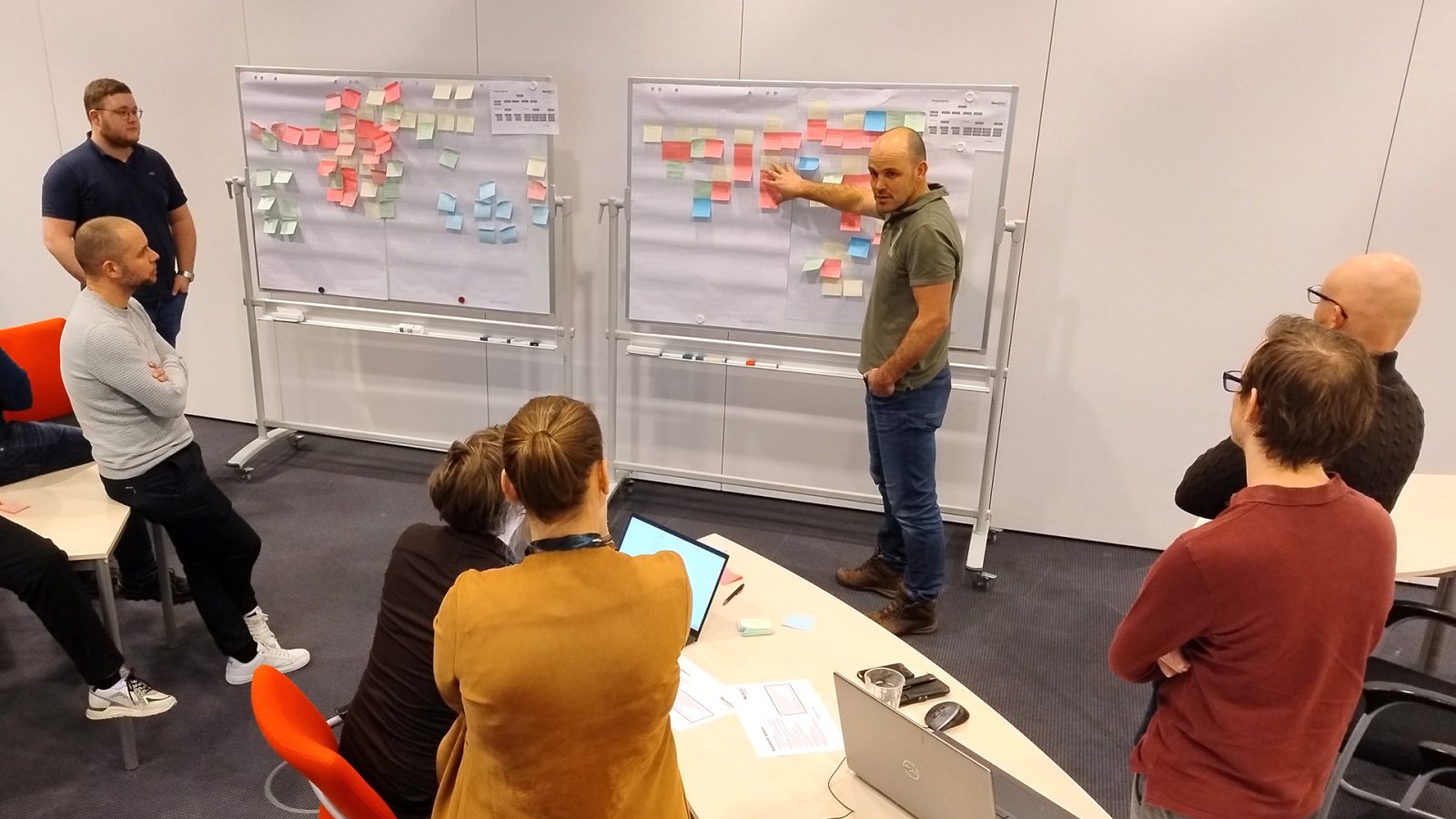
That is why we first mapped the existing organisation. What is going well? Where do colleagues experience challenges? Which elements of our collaboration do we absolutely want to preserve? We then presented that analysis to the rest of the organisation during a feedback session. This allowed us to validate whether our findings matched the experiences of our colleagues.
It quickly became clear that one element absolutely had to remain: our project teams. At MechDes, we create a team for each project with exactly the right expertise. Once a project is completed, new teams are formed again. This way of working creates flexibility, variety and a great deal of knowledge sharing. That was something we did not want to change.
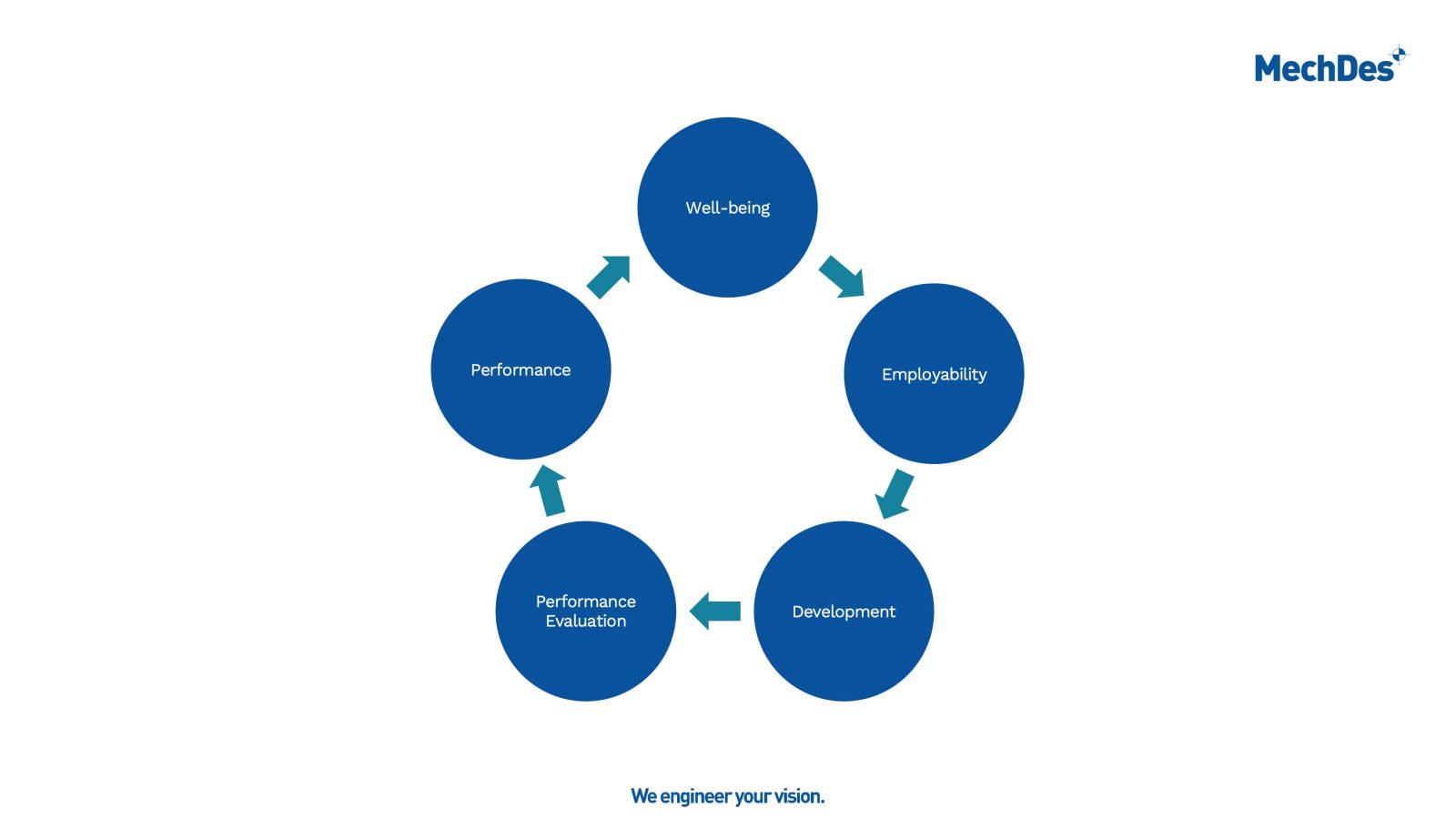
At the same time, we saw that the organisation had grown large enough to organise certain things more intelligently. The market is changing quickly and requires engineers who can be deployed more broadly. In addition, we wanted to create more attention for the development, performance and wellbeing of our colleagues.
The search for the right balance
During the brainstorming sessions, an initial version of the new organisational chart emerged surprisingly quickly. Yet one question kept coming back. How do you maintain the flexibility of changing project teams while ensuring that every employee receives enough attention for their personal development?
That led to some strong discussions. Sometimes we stayed on one topic for a surprisingly long time, because everyone looked at the same challenge from their own experience. Not because we had different goals, but precisely because everyone cares deeply about MechDes. Some wanted to mainly preserve what already worked well. Others saw opportunities to organise things more intelligently. Looking back, I realised that beliefs and emotions played an important role in this process. In myself as well as in others.
For me, this also contained an important lesson about ownership, although that may not seem immediately obvious. Ownership means keeping the shared goal in mind: achieving the best possible result for MechDes. You cannot achieve that alone. The best solutions emerge through collaboration and by genuinely listening to each other.
That requires more than simply hearing what someone says. It also means being open to the reasoning behind their words and evaluating your own position just as critically and honestly as someone else's. Good decisions are not created because everyone thinks the same way, but because different insights come together and strengthen each other. It is precisely this diversity of perspectives that leads to better solutions.
For the final challenge regarding the management of a large group of engineers, we eventually involved an external advisor. Together with three committee members and the management team, the structure was then further developed.
The result: a matrix organization with the engineer at the center
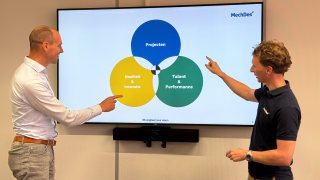
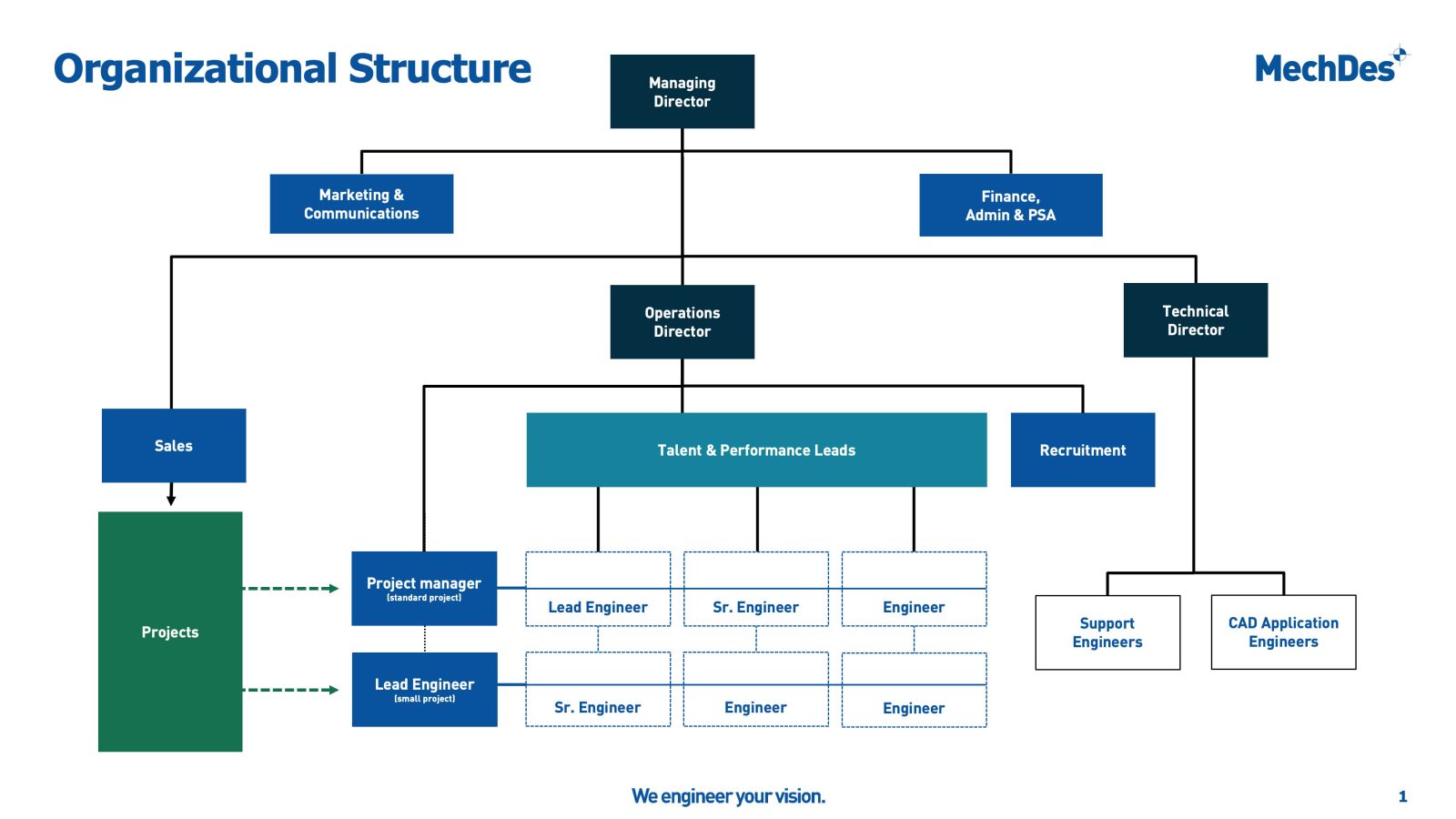
Ultimately, we arrived at a matrix organization. Not because we specifically wanted a matrix structure, but because this model best aligns with the way MechDes works and with our ambitions for the future. For me, this was the moment when everything came together. All the discussions about roles, responsibilities, and collaboration eventually fell into place within one structure that felt surprisingly logical.
At the heart of the organization are our engineers and project teams. This is our core activity and what everything ultimately revolves around: designing high-quality technical solutions for our customers. This has always been the strength of MechDes, and it is exactly that strength we wanted to preserve.
The biggest difference compared to the previous situation is that engineers are no longer divided across two business units but are now part of one shared group. This allows us to share knowledge more easily, assemble project teams more flexibly, and respond faster to changes in the market. At the same time, it creates more opportunities for personal development and professional growth.
Around this core, three supporting pillars have been organized. Each pillar has its own role. Together, they ensure that project teams can perform at their best.
On the customer side, Sales, Business Development, and Project Management ensure that customers are supported from the first contact through to project delivery. Project Managers remain involved throughout the entire process, further strengthening collaboration and service delivery.
On the other side, the technical pillar supports the project teams. Our Technical Director, together with our Development and Support Engineers, forms the technical conscience of the organization. They develop tools, share knowledge, and safeguard the quality that customers have valued MechDes for over many years.
The 'indirect employees' and management connect these different parts of the organization. They ensure that the right balance is continuously maintained between customer, project, and employee needs. This creates an organization that is not only agile but also provides room for ownership, responsibility, and continuity.
Our new Operations Director Mark Rankenberg sees this as the exact strength of the new structure: "What appeals to me is that we are not choosing between growth and attention for our people. Instead, we are deliberately bringing both together. Project Managers and Lead Engineers provide focus and clarity within projects, while Talent & Performance Leads ensure that our people continue to develop. We truly do this together. This allows us to keep growing without losing the commitment that defines MechDes."
More than a new organizational chart
When the structure was further developed, it naturally also became a topic for the works council. From that moment on, I was no longer looking at the proposal as a committee member, but as a works council representative. It is not about your personal preference, but about whether the choices are right for the organization and for all employees. To me, that is what ownership means: looking beyond your own role and acting based on what is best for MechDes as a whole.
The works council once again showed how important good communication is. Many challenges can be resolved much faster by sitting down together than by endlessly exchanging emails. Looking back, I am especially proud of the way this process unfolded. Not because we created a new organizational chart, but because employees were genuinely given the opportunity to help shape the future of MechDes. That level of trust is not something you find everywhere.
As an engineer, you are used to designing solutions for customers. This time, we were essentially building our own organization. That made this journey even more special for me. Perhaps that is the biggest lesson I take away from this experience. Good engineering is about collaboration, listening, and continuously improving. Apparently, the same principles apply to an organization. I look forward to seeing how we continue to develop this way of working together in the years ahead.
We engineer your vision... and our future.