
Introduction
Product development rarely starts with a blank sheet of paper. In practice, it begins with a question that has not yet been answered properly. A process that needs to become more efficient. A product that is vulnerable. Or an application for which existing solutions just do not quite fit.
Especially in industries such as intralogistics, food, pharma and offshore, standard solutions often fall short. Not because they are poor solutions, but because they are designed for a much broader range of applications than required. They are too heavy, too complex, or simply not tailored to the specific application. The challenge is therefore not to invent something completely new. The challenge is to develop something that is exactly sufficient. Smart enough and economically viable.
At MechDes, product development is therefore not just about creating, but above all about understanding.
Understanding Before Designing
A good design starts with asking the right questions. What does a machine really need to do? Where is the value for the customer? And just as importantly: what is actually unnecessary?
In practice, many machines and systems have been designed with generous safety margins. That makes sense, especially for generic solutions. But once they are used for a specific application, opportunities for optimization emerge.
A robot capable of lifting 35 kilograms is impressive. But if the application only requires lifting 2 or 5 kilograms, the entire design challenge changes. It becomes clear how much of that capacity is never actually used. That opens the door to a different design. Lighter. More compact. Less complex. And often faster and more accurate, because there is no longer a need to compensate for mass that serves no real purpose.
This requires a different way of thinking. Not based on what is available, but on what is actually needed. We call this the "less is more" design principle, which is deeply embedded in the engineering philosophy of MechDes engineers.
From Generic to Application-Specific
In many applications, standard components provide a logical starting point. Think of industrial robots, drive systems or sensors. But standard solutions are rarely a perfect fit. An important distinction is the one between the robot itself and the end-of-arm tooling. The robot provides the motion. The tooling determines what actually happens.
That tooling is almost always application-specific. A gripper for cardboard boxes requires a completely different approach than a solution for delicate pharmaceutical products. And an offshore application demands something entirely different again, where compliance and flexibility are essential. Take, for example, a system that connects a ship to shore power. It requires precision to establish a safe connection. At the same time, the system must be able to accommodate movement caused by waves and tides.
That means being precise where necessary, and tolerant where possible. It is this combination that makes product development both interesting and technically challenging.
The Triangle of Design Trade-offs
In almost every development project, the same trade-off returns: speed, accuracy and force. Ideally, you want to optimize all three. In practice, that is rarely achievable.
Greater accuracy often requires finer transmission ratios, which usually results in lower speed. More force means more mass. And higher speed can come at the expense of control. Every application requires a different balance. For package handling, speed may be the primary objective. In the pharmaceutical industry, controlled motion and reliability take priority. And in offshore applications, robustness is often more important than absolute precision.
Good engineering therefore means making deliberate choices, always in relation to the application.
Collaboration as a Driver for Custom Solutions
A frequently asked question is when a custom solution becomes worthwhile. The honest answer: not always. The best solutions rarely emerge from a single discipline. Mechanics, electronics and software are inseparably connected.
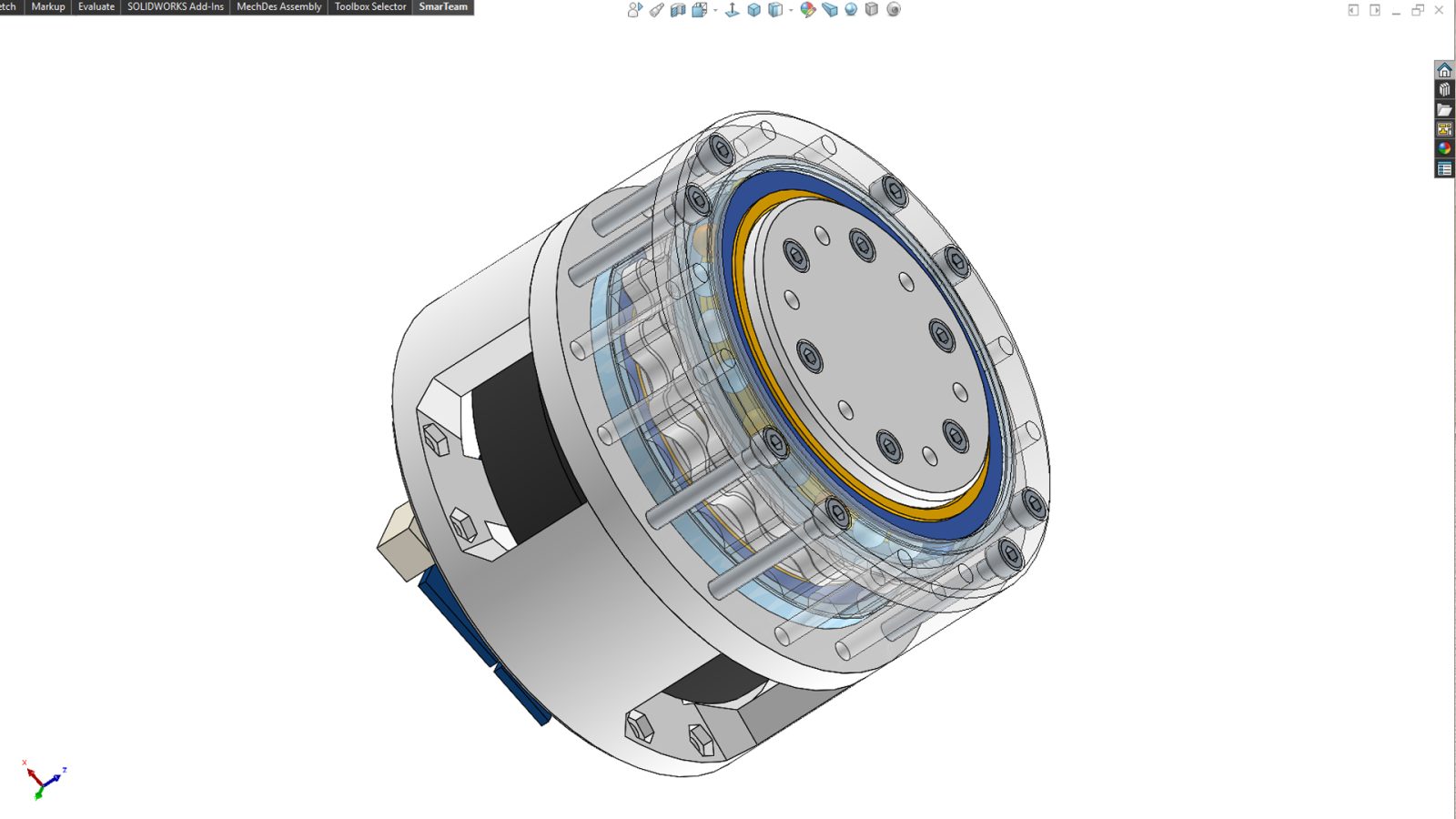
In practice, this requires close collaboration, which is why we strongly believe in co-creation. For example, when integrating sensors, developing compact electronics or optimizing control systems. For a one-off solution, a standard component is often the best choice. The development costs of a custom solution simply do not outweigh the benefits. However, as soon as larger production volumes come into view, the equation changes. If a solution will be applied dozens or even hundreds of times, a custom design can become highly attractive. It can reduce material usage, shorten cycle times, lower cost per unit and improve overall performance.
Making that assessment is an essential part of product development. Not only from a technical perspective, but also from an economic one. At MechDes, we therefore always evaluate the business case. What is the best solution, not only for today, but also for the application over the long term? Sometimes the conclusion is that developing a custom solution simply is not the right choice. That honesty is what makes the difference.
Regulations as a Design Parameter
Product development does not end with functionality. Especially in industries such as food and pharmaceuticals, regulations play an increasingly important role. What complies with today's standards may be outdated tomorrow. Hygiene requirements, safety and certification are not afterthoughts. They are design principles from the very beginning. At the same time, regulations continue to evolve. A machine designed today must also be able to meet the requirements of tomorrow.
This requires forward thinking. Which standards are on the horizon? What do they mean for material selection, cleanability or structural design? By asking these questions early, costly modifications later in the project can often be avoided.
The Role of AI and Generative Design
New technologies continue to accelerate product development. AI makes it possible to leverage knowledge more quickly. Generative design enables designs to emerge based on predefined constraints.
Instead of modeling step by step, you define what a component must be able to do. Where the loads are applied. How much design space is available. The software then generates a geometry that satisfies those requirements. Combined with additive manufacturing, this creates an enormous degree of design freedom. At the same time, the role of the engineer remains essential. Technology accelerates the process, but it does not replace engineering judgment.
The real value lies in defining the right constraints and evaluating the outcome. That requires a different way of working. Engineers who not only model and calculate, but also structure, formulate and iterate. Prompting is becoming increasingly important in this process. Effectively guiding AI, asking precise questions and iteratively refining its output make the difference. Combined with training models on proprietary data and project experience, this creates a powerful foundation.
The Future: Making Smarter Choices
The future of product development does not lie in a single technology, but in intelligently combining different capabilities. Learning more quickly from existing solutions. Better understanding what should and should not be adopted. And designing with manufacturability, cost and regulatory compliance in mind from the very beginning. As a result, the role of the engineer is evolving. Less time spent drawing, more time analyzing and guiding decisions. The best solutions are not created by doing more, but by making better choices.
And that is exactly where MechDes makes the difference.
About MechDes Engineering
MechDes is a creative and forward-thinking mechanical engineering consultancy with more than 30 years of experience in developing smart technical solutions. Based in Harderwijk, MechDes delivers engineering projects across industries including intralogistics, infrastructure and offshore.
The strength of MechDes lies in combining in-depth technical expertise with a pragmatic approach. We do not engineer for the sake of engineering, but focus on what truly works in practice. From the initial concept through realization and optimization, MechDes works alongside its clients to develop the right solution, both technically and economically.
With a strong focus on collaboration and co-creation, MechDes develops solutions that are not only technically sound on paper, but also deliver real value in everyday applications. Innovative, thorough and committed, with one goal: engineering technology that creates lasting value.